Can a Dietitian Help You Lose Weight? What to Expect From Personalised Support

TL;DR
- Yes. A large review of 62 trials found dietitian-led programs produced about 4% more weight loss than usual care, plus smaller waists and lower blood pressure.
- Results depend on staying in touch: about five or more sessions over a year works best, and benefits fade within a few months of stopping.
- In Ontario, "dietitian" and "RD" are legally protected titles. "Nutritionist" isn't, so anyone can use it.
- Your first appointment is an assessment of your health, habits and goals, not a printed diet handed across the desk.
- Dietitians can't prescribe medication, but they're valuable if you take a GLP-1: protecting muscle, easing side effects and filling nutrient gaps.
- OHIP doesn't cover private-practice dietitians. Free options include Health811, Community Health Centres, Family Health Teams and diabetes education programs, and many workplace plans cover private visits.
If you've tried three diets, two apps and one very expensive meal-delivery subscription, the idea of paying someone to tell you what to eat probably sounds less than thrilling. Fair enough.
A good dietitian doesn't do that, though. The job is closer to troubleshooting: figuring out why the last plan fell apart, what your medical history changes, and what you'll still be doing a year from now. The research on dietitian and weight loss outcomes is more honest than most marketing, too. The gains are real, they're moderate, and they depend heavily on sticking with it.
Below, we cover who's actually qualified, how appointments work, and how Ontarians can get this kind of help, sometimes for free.
Can a Dietitian Help You Lose Weight? What the Research Says
Yes, by a meaningful but not dramatic margin. The biggest review to date, published in 2023 by the Academy of Nutrition and Dietetics, pooled 62 randomized trials and found that dietitian-led programs produced about 4% more body-weight loss than usual care. For someone at 100 kg, that's roughly 4 kg more. The same review found waists about 3.5 cm smaller and systolic blood pressure about 3 points lower, and those changes matter for heart and diabetes risk regardless of what the scale says.
You may see a smaller number quoted in Canadian sources: about 1 kg. That figure comes from five trials of brief, mostly one-off consultations. The gap between the two numbers is the lesson. Seeing a dietitian for weight loss once does little. A relationship does more.
The Academy's guidance recommends at least five sessions over at least a year, then check-ins at least every three months. Benefits tend to fade within about three months of stopping contact, and ongoing support after the main program reduces weight gain by roughly 1.5 to 3 kg in pooled studies. Weight maintenance, it turns out, is the part people most often try to do alone.
Where dietitians really shine is metabolic health. Nutrition therapy from a dietitian lowers A1C by 1 to 2 percentage points in people with diabetes, according to Diabetes Canada, and the landmark Diabetes Prevention Program cut new diabetes cases by 58% with an intensive lifestyle program. Canada's adult obesity guideline gives its top evidence grade to individualised nutrition therapy from a registered dietitian.
One thing the evidence doesn't support: DNA-based or microbiome-based "personalised" diets. Trials testing them found no added benefit over good individual advice. Personalised, in the useful sense, means fitted to your health, culture, budget and schedule.
Dietitian vs Nutritionist for Weight Loss: The Difference Is Legal
In Ontario, only members of the College of Dietitians of Ontario can call themselves a dietitian, Registered Dietitian or RD. Getting there takes a four-year accredited degree, supervised practical training and a national registration exam. Using the title without registration can bring fines of up to $50,000, according to the College.
"Nutritionist" has no such protection here. A holistic nutritionist might have useful training, or a weekend certificate. You can't tell from the title, and in a 2020 survey of Ontario adults, almost three in four didn't know the difference. Clients of unregulated nutritionists also reported getting supplement recommendations nearly twice as often as dietitians' clients did. Draw your own conclusions.
Two quick checks protect you. Look your dietitian up on the College's public register. And be wary of fancy add-ons like "medical dietitian" or "certified weight loss specialist," since the College doesn't recognise any specialties. One more wrinkle: a dietitian based in another province who sees you virtually must still be registered in Ontario.
What to Expect at a Dietitian Appointment
The first visit is mostly listening. Expect 45 to 75 minutes, depending on the setting, covering your medical history, medications and supplements, lab results if you have them, what a normal day of eating looks like, your weight history, sleep, activity, budget and the foods your culture and family revolve around. Then you set goals together. By law in Ontario, a dietitian needs your informed consent before starting any treatment plan.
Follow-ups are shorter, usually 30 to 60 minutes, and they're where the actual work happens: what went well, what didn't, what to adjust. There's no fixed Canadian schedule, so the pace is agreed between you.
A little preparation makes the first visit far more useful. Bring a list of your medications and supplements, any recent bloodwork, and two or three days of honest food notes (the Tuesday you ate cereal for dinner counts). Knowing your rough body measurements helps as well; our BMI calculator also gives you a waist-to-height ratio, which adds context BMI misses.
Meal Plan or New Habits? Mostly Habits
If you're hoping for a laminated seven-day menu, a dietitian may hand you a sample plan as a starting point. Most of the work is something else.
Canada's obesity guideline is blunt about why: there's no one-size-fits-all eating pattern, and plain calorie restriction rarely holds past 12 months. Keto, Mediterranean, intermittent fasting and low-fat all produce similar results over six months to a year when calories match. So the useful question isn't which diet. It's which version of eating you'll still be doing next summer. That's the core of building sustainable habits for weight management, and it's where a dietitian earns the fee.
In practice that means things like reworking the 4 p.m. vending-machine run, planning around shift work or kids' hockey, making weeknight dinners from the groceries you actually buy, and figuring out a realistic calorie range. (Our maintenance calories calculator gives you a starting estimate to bring along.) It also means noticing patterns like emotional eating; a good dietitian will refer you to a psychologist when that's the real problem.
PCOS and insulin resistance. Both are good reasons to see a dietitian. The international PCOS guideline recommends lifestyle support for everyone with the condition, says no single diet is superior, and specifically warns against overly restrictive plans. A dietitian can help you spread carbohydrates sensibly, build meals around protein and fibre, and keep blood sugar steadier without cutting out entire food groups. If insulin resistance is part of your picture, our guide to losing weight with insulin resistance covers the medical side.
And if you've already done everything right and the scale has stopped moving? That's common, and not a sign of failure. Understanding a weight-loss plateau helps you tell a true stall from normal fluctuation before you change course.
On Weight-Loss Medication? A Dietitian Matters More, Not Less
A common assumption is that GLP-1 medications make nutrition advice redundant. We'd argue the opposite.
When appetite drops sharply, people often eat too little protein and too few nutrients without realizing it. In the STEP 1 trial of semaglutide, about 38% of the weight people lost was lean mass (a measure that includes water and organs as well as muscle). That's why a 2025 advisory from four major nutrition and obesity organisations put protein, strength training and nutrient adequacy at the top of the list for anyone on these drugs, along with practical strategies for nausea and constipation. A dietitian can turn that into meals you'll tolerate on a low-appetite day. Our piece on preserving muscle while reducing body fat explains why muscle is worth protecting.
The division of labour is clear. Dietitians can't prescribe medication in Ontario, and they can't order bloodwork on their own. A physician handles the prescription, the monitoring and the medical decisions; the dietitian handles how you eat around it. Canada's obesity guideline treats medication as an addition to health behaviour changes, not a replacement for them.
To be fair about the evidence: no trial has yet compared GLP-1 medication with dietitian support against medication alone. The case rests on expert consensus and common sense. It's also worth planning ahead, because trials show most people regain a large share of the weight within a year of stopping these drugs, and habits built with a dietitian are what you keep.
Finding a Weight Loss Dietitian in Ontario: What's Covered
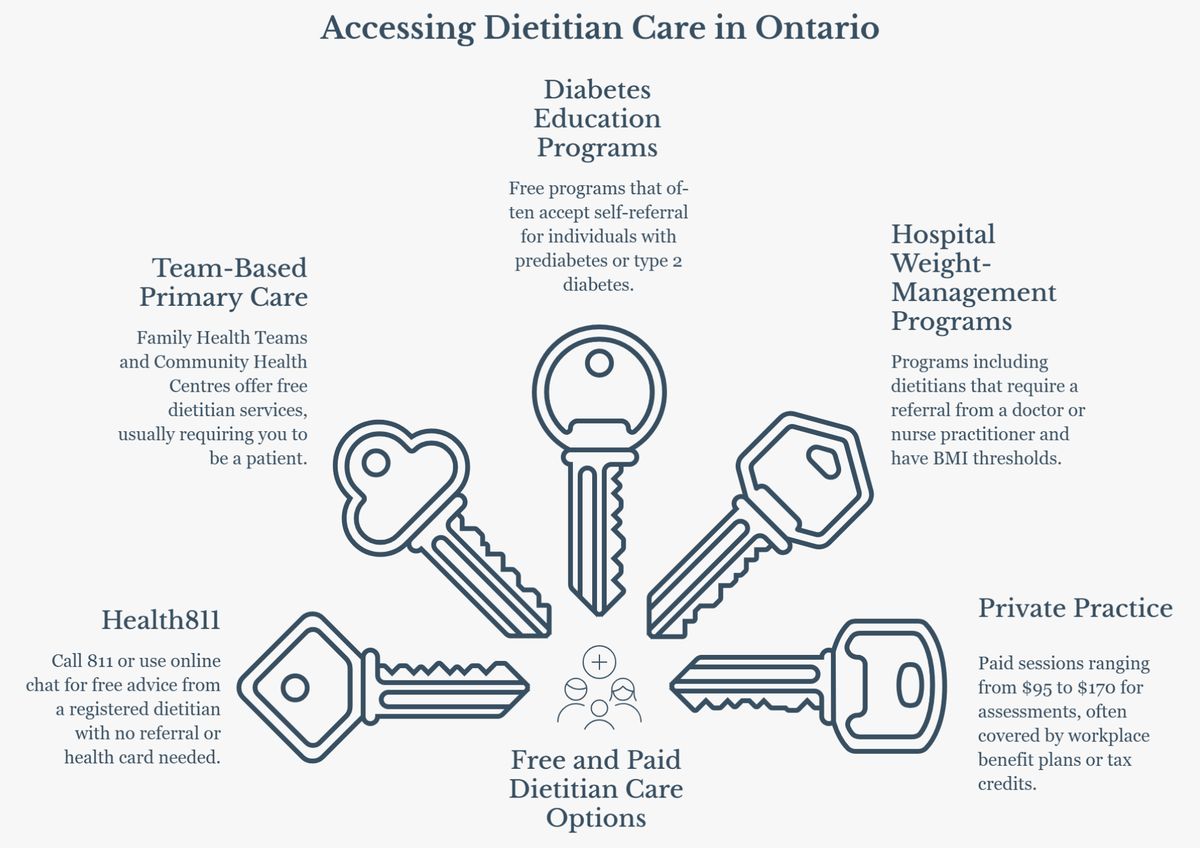
OHIP doesn't pay for private-practice dietitians; dietitians aren't on Ontario's list of OHIP-covered services. Free dietitian care does exist, though, if you know where to look.
Health811
Call 811 (TTY 711) or use the online chat to speak with a registered dietitian at no cost. No referral, no health card number needed. It's advice rather than ongoing counselling, but it's a solid first step.
Team-Based Primary Care
Many Family Health Teams and Community Health Centres have dietitians on staff, free for their patients or local residents. The province has been funding more of these teams since 2024, though you usually need to be a patient there to book.
Diabetes Education Programs
Free, and many accept self-referral if you have prediabetes or type 2 diabetes.
Hospital Weight-Management Programs
These include dietitians, but they need a referral from a family doctor or nurse practitioner and have BMI thresholds.
That last requirement is where many people hit a wall. Nearly 2 million Ontarians had no regular primary care provider in 2025, which shuts them out of most free team-based options. A physician-led program is another route to accessing weight-management care in Ontario, and you can still bring a dietitian into the picture alongside it.
Private Practice
Published Ontario examples run from about $95 to $170 for an initial assessment and $30 to $90 for follow-ups, with virtual sessions widely available. No referral is needed. Many workplace benefit plans cover dietitians up to an annual maximum (one Ontario employer plan, for example, covers 80% up to $841 a year), and some may also count toward the medical expense tax credit, so keep your receipts. Plans typically pay for registered dietitians, so check before booking with a "nutritionist."
Pair Good Nutrition Support With the Right Medical Care
A dietitian can fine-tune how you eat. Some questions still need a doctor: whether a medical condition is slowing you down, whether bloodwork is needed, and whether medication belongs in your plan.
That's where WhyWeight comes in. We connect you with weight management doctors who help you get a handle on cravings, build habits that last, and prescribe medication when it's the right call. Your consultation is free and 100% covered by OHIP, and the plan you build with your doctor can sit right alongside the work you do with a dietitian.
Our weight loss service starts with a two-minute assessment, with no registration required. If you've been going it alone, it's a simple way to get real weight loss help from a physician.
Frequently Asked Questions
1. Can a dietitian help me lose weight if diets have not worked before?
That history is actually the best reason to see one. Most diets fail because they're too restrictive to last, and Canada's obesity guideline notes calorie restriction alone rarely holds beyond a year. A dietitian works backward from what went wrong last time and builds something you can sustain.
2. What happens at the first dietitian appointment for weight management?
An assessment, mostly. Expect 45 to 75 minutes of questions about your health, medications, eating habits, routine and goals, and then a plan you agree on together. Bring your medication list, recent bloodwork and a few days of food notes if you can.
3. What is the difference between a dietitian and a nutritionist?
Regulation. In Ontario, "dietitian" and "RD" are protected titles requiring a degree, supervised training, an exam and College registration. "Nutritionist" isn't protected, so training varies from extensive to almost nothing.
4. Will a dietitian give me a meal plan or help me build eating habits?
Mostly habits. You might get sample meal plans or recipes as tools, but the focus is changes that fit your life, your culture and your budget.
5. Can a dietitian support people with PCOS or insulin resistance?
Yes, and lifestyle support is recommended for everyone with PCOS. A dietitian can help you structure meals to keep blood sugar steadier without the overly restrictive diets the international PCOS guideline warns against.
6. Can I work with a dietitian while taking weight-loss medication?
You should, ideally. A dietitian can help you get enough protein, ease nausea and constipation through food choices, and avoid nutrient gaps when your appetite is low. Your prescribing doctor manages the medication itself.
7. How often should I see a dietitian for weight-management support?
There's no set rule, but research favours at least five sessions over about a year, then check-ins every few months. Early on, every few weeks is common.
8. Are dietitian appointments covered by OHIP or private insurance in Ontario?
Private-practice visits aren't covered by OHIP. You can speak with a dietitian free through Health811, and Family Health Teams, Community Health Centres and diabetes programs offer free care to eligible patients. Many workplace benefit plans cover registered dietitians up to an annual limit, so check yours and keep your receipts.