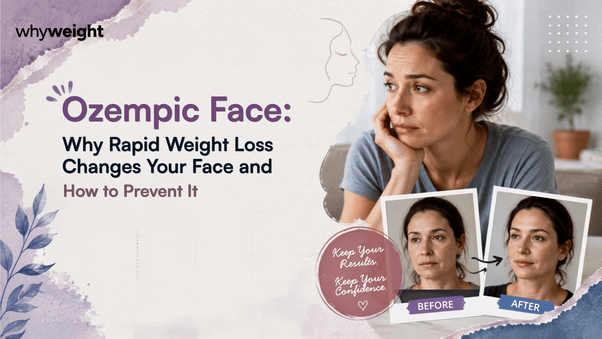
Ozempic Face: Why Rapid Weight Loss Changes Your Face, and How to Prevent It
TL;DR
- Ozempic face is real: rapid weight loss on GLP-1 medication depletes facial fat pads, mimics accelerated aging, and appears to directly impair the skin's ability to regenerate collagen and elastin, not just "less fat under the skin."
- The Ontario twist: many people start Ozempic or Wegovy in the fall or winter. Coats and scarves hide the early changes, and Ontario's dry winter air already stresses skin elasticity, so the hollowing goes unnoticed until summer, when Toronto's UV index climbs to "very high" and accelerates the exact collagen breakdown that causes it.
- Slower weight loss helps, but it isn't the whole answer. Pace matters, but protein intake, hydration, resistance training, and daily SPF, started the same season you start your medication do more to prevent GLP-1 face sagging than pace alone.
- Ozempic face is largely treatable, not permanent: one clinical study found 85.7% of participants reported a less gaunt appearance after targeted treatment, and a 12-week trial of topical skincare during active GLP-1 weight loss reduced wrinkle severity by 20.7% and improved skin elasticity by 23.2%.
- WhyWeight connects you directly with physicians who prescribe proven GLP-1 treatments when it's appropriate for you. WhyWeight pairs this prescription with a detailed and customized plan for nutrition, diet, exercise and emotional eating. Our weight loss program builds the pace, nutrition, and monitoring that prevent facial volume loss directly into your plan, instead of leaving you to notice the change in a July photo.
This article is educational content, not medical advice. Talk to your prescribing physician or care team before changing your medication, diet, or exercise routine.
If you filled your first Ozempic or Wegovy prescription this past winter, there's a good chance you haven't noticed anything different about your face yet. You've been in a parka for four months. That's about to change.
New York dermatologist Dr. Paul Jarrod Frank started noticing a pattern in his patients back in 2022: people losing significant weight on GLP-1 medications who felt better on the scale but told him they somehow looked older. He gave it a name, "Ozempic face", in a New York Times interview in January 2023, saying, "I see it every day in my office”. Three years later, it's one of the most-searched side effects of GLP-1 treatment, and with roughly 1 in 8 U.S. adults having used a GLP-1 medication, it's not a fringe concern anymore.
Here's what actually causes it, why Ontario's climate makes the timing especially unkind, and the specific, evidence-backed plan that prevents it, starting the season you start your medication, not the season you notice the change.
If you’re looking to lose weight but don’t know where to start, and want to do it in a structured, guided way to avoid issues like Ozempic face, then you’re at the absolutely right place. At WhyWeight, we connect you to accredited, weight management physicians for OHIP-covered, online consultations. These physicians can prescribe proven weight loss medications like Wegovy and Zepbound, along with a customized plan on diet, exercise and behavioral therapy. All consultations are OHIP-covered and are purely done online. Just complete a free, 2 minute assessment to start your own weight loss transformation journey now.
What Is Ozempic Face and Why Does It Happen?
Ozempic face isn't a drug side effect in the pharmacological sense, no medication label lists it. It's a predictable consequence of losing facial volume quickly: sunken cheeks and temples, hollowing around the eyes, deeper nasolabial folds and wrinkles, and looser skin along the jaw and neck.
Three things are happening at once.
1. Facial Fat Pads Shrink Faster Than You'd Expect
The face relies on distinct, mostly non-renewable fat pads, buccal, malar, temporal, periorbital, for youthful fullness and contour. Because facial fat is comparatively thin to begin with, rapid weight loss can deplete it noticeably fast; one figure puts average midface volume loss on Ozempic at around 7%.
2. It Mimics and Compresses Normal Aging
Losing facial fat is something that happens to everyone with age. GLP-1-driven weight loss just does it much faster. As Dr. Vinni Makin of Cleveland Clinic puts it: "Rapid weight loss can cause these processes to occur more rapidly, which can mimic the natural aging process."
3. GLP-1s May Directly Affect the Cells That Make Collagen and Elastin — Not Just Fat
This is the detail that separates GLP-1-related facial changes from ordinary diet-driven weight loss. Dermatologist Dr. Sabrina Fabi notes that GLP-1 medications appear to act on adipocyte-derived stem cells, reducing their glucose uptake and impairing their ability to regenerate fat, collagen, elastin, and hyaluronic acid, the proteins that keep skin firm and bouncy. A 2025 literature review found that as fat mass drops on semaglutide, collagen accumulation drops right along with it, not just volume, but the skin's structural capacity to hold its shape. Skin laxity tends to show up worst in the chin, neck, jaw, and lower face.
Speed matters independent of how much weight you lose, rapid loss doesn't give skin time to "recoil" and re-drape the way slower, more gradual loss does, which is part of why Wegovy and other fast-acting GLP-1 medications get singled out in this conversation more than older, slower weight-loss methods.
The Ontario Seasonal Trap
This is the part most "Ozempic face" articles miss, and it matters specifically if you live here.
Winter Is When a Lot of People Start
New Year's resolutions are a well-documented driver of weight-loss program starts, and recent prescribing data shows first-time anti-obesity medication prescriptions jump sharply from December to January and stay elevated, GLP-1 prescriptions grew 15.0% quarter-over-quarter in the most recent tracking period, the largest jump on record.
Ontario Winters Are Actively Working Against Your Skin During That Exact Window
Cold outdoor air holds less moisture, and indoor forced-air heating strips humidity further, both increasing water loss through the skin and reducing its ability to stay plump and elastic. That's precisely when someone who started Ozempic or Wegovy in November or December is also losing facial fat fastest. Dermatologists consistently recommend richer moisturizers, humidifiers, and barrier-repair ingredients through an Ontario winter for exactly this reason.
And You're Covered Up, so You Don't See It Happening
Coats, scarves, hats, there's no equivalent to noticing your jeans fit differently. The face is the one place people check daily, in the mirror or on video calls, but gradual change is easy to discount until it isn't.
Then Summer Arrives, and Toronto's UV Index Climbs to 7–8+ — "Very High" to "Extreme"
Through June, July, and August, Toronto's UV index sits in that range. UV exposure directly accelerates collagen and elastin breakdown, compounding the volume loss that already happened over the winter, right as patio season, weddings, cottage trips, and reunion photos put your face in front of a camera far more often.
Put together: someone who started medication in November, lost weight through a dry Ontario winter with no sun-protection routine because "it's winter, why would I need SPF," surfaces in June already months into skin structure decline and then spends the sunniest months of the year actively accelerating the exact damage they'd want to prevent.
The fix isn't a summer skincare tip. It starts with your skin plan the same week you start your medication, whatever season that happens to be, because losing weight too fast creates problems beyond the scale, and your face is one of the places that shows up first.
How Common and How Treatable Is This?
Ozempic face isn't rare, and it isn't permanent for most people.
On the scale side: fat-grafting procedures surged 50% in 2024, directly attributed to GLP-1-related facial volume loss, and Gen X alone accounted for nearly 11 million minimally invasive cosmetic procedures that year, with facelifts now common in patients a decade younger than the historical norm.
On the treatable side: a clinical study of injectable volume-restoration treatment found 85.7% of participants reported a less gaunt appearance by week 40, and 91.4% said they'd recommend it. Even simple topical skincare, used during ongoing weight loss, made a measurable difference in a 12-week clinical trial of adults losing weight rapidly from GLP-1/GIP medications: wrinkle severity dropped 20.7%, skin thickness increased 20.1%, hydration rose roughly 19–21%, and skin elasticity improved 23.2%, with excellent tolerability.
In other words: this is a real, common, and manageable part of GLP-1 treatment, not a reason to avoid a weight loss service that could meaningfully improve your health, and not something you have to just accept, either.
How to Prevent Ozempic Face: A Season-by-Season Plan
Complete prevention isn't guaranteed, but the levers below are the ones the evidence actually supports and timing them to Ontario's seasons is what makes this plan different from a generic skincare checklist.
Does Slower Weight Loss Prevent Ozempic Face?
Partly, yes. Losing weight at a more gradual pace, roughly 1–2 lbs per week rather than the fastest rate your dose allows, gives skin more time to adapt as fat pads shrink. This should be a conversation with your prescribing physician about titration pace, not a DIY dose change. It's also the same principle behind slowing the pace of weight loss to protect muscle and facial volume more broadly, pace protects more than just the number on the scale. But pace alone isn't the full answer; the nutrition and skin-support steps below matter just as much.
If You're Starting Your Medication in Fall or Winter
- Protein: 20–30g per meal, or roughly 1–1.5g per kg of body weight per day. Protein supports the structural proteins in both muscle and skin during active weight loss. A maintenance calories calculator can help you figure out roughly how much you're eating overall so protein targets aren't guesswork.
- Hydration and humidity indoors. Aim for 4–8 glasses (1–2L) of water daily, and counter Ontario's dry, forced-air-heated winters with a humidifier and richer, barrier-repair moisturizers (look for ceramides and hyaluronic acid).
- Resistance training, 2–3x/week. This protects lean mass generally, which supports overall tissue structure, not just muscle.
- Don't skip SPF just because it's winter. UV exposure is lower, but it isn't zero, and building the daily habit now means it's already automatic by the time summer UV peaks.
If You're Heading into an Ontario Summer
- Daily SPF, no exceptions. Toronto's UV index averages around 7.9 in July, "very high." This is the single most-skipped step for people who started treatment in winter, and the one most likely to compound existing collagen loss.
- Keep the protein and hydration habits going, they don't stop mattering once the weather warms up.
- Layer in supportive topical activities: hyaluronic acid for hydration, vitamin C as an antioxidant and collagen supporter, retinol to stimulate collagen production, and gentle, non-stripping cleansers.
- Avoid compounding damage. Smoking and heavy alcohol use both accelerate collagen breakdown independent of weight loss, and restrictive or crash dieting on top of GLP-1 appetite suppression increases the risk of facial hollowing from actual malnutrition, not just fat loss.
If You're Already Noticing It
If the Ozempic face is already visible, you have real options but it's worth knowing upfront that these are elective cosmetic treatments, not covered by OHIP.
- Non-surgical: dermal fillers (hyaluronic acid) to restore lost volume, collagen-stimulating injectables, radiofrequency or microneedling skin-tightening, PRP injections, and Botox.
- Surgical (for more advanced cases): fat grafting, facelifts, and cheek implants, procedures that have become notably more common and are now performed on patients a decade younger than historical norms, largely attributed to GLP-1-driven facial volume loss.
These are worth discussing with a dermatologist or plastic surgeon if you want them, but they treat the result, not the cause. Prevention, built into your weight-loss plan from the start, is the more direct route.
Why This Is Easier with a Structured Program
Knowing that pace, protein, hydration, and SPF matter is one thing. Actually building all four into your routine, while managing medication, appetite changes, and an Ontario winter, is another.
This is where a physician-led, coached approach helps. WhyWeight connects you directly with physicians who prescribe and actively monitor your GLP-1 treatment when it's right for you, not a one-time prescription and a "good luck." That medical oversight is paired with personalized nutrition, fitness, and progress monitoring, so the protection strategies in this article aren't left to chance, they're part of your plan from week one, adjusted by your care team based on how you're actually responding, not guessed at. As an OHIP-covered weight loss program, that physician access and support is available in Ontario at no direct cost.
If you're currently on, or considering, Ozempic or Wegovy for weight loss, and want guidance and a structured weight loss plan tailored to your unique health goals and challenges, then we strongly recommend you to get in touch with us. We offer OHIP-covered weight loss consultations, connecting you with weight loss physicians across Ontario for online weight management consultations, all covered by OHIP. There is no commitment required from your end and it all starts by filling out our free, 2 minute assessment.
Frequently Asked Questions
1. What Causes Ozempic Face?
Ozempic face is caused by a combination of three things: rapid depletion of the face's fat pads, an accelerated version of the facial volume loss that normally happens with age, and increasingly supported by research, a direct effect of GLP-1 medications on the skin cells responsible for producing collagen, elastin, and hyaluronic acid. It's the speed of the change, not just the amount of weight lost, that makes it noticeable.
2. Can Ozempic Face Be Reversed?
In most cases, yes, at least partially. Non-surgical treatments like dermal fillers, collagen-stimulating injectables, and skin-tightening procedures have shown strong results, one study found 85.7% of participants reported a less gaunt appearance after treatment. Even topical skincare used during active weight loss has shown measurable improvement in skin thickness, hydration, and elasticity in clinical trials. Severe cases may require surgical options like fat grafting or a facelift.
3. How Do You Prevent Facial Sagging While on Weight Loss Medication?
The strongest evidence-based strategies are: losing weight at a moderate pace (roughly 1–2 lbs/week) rather than the fastest rate possible, eating enough protein (20–30g per meal), staying well hydrated, using daily sunscreen year-round, and supporting skin with hyaluronic acid, retinol, and vitamin C. In Ontario, it also means countering winter's dry indoor air with humidity and richer moisturizers, since that's often when GLP-1 treatment, and the fastest facial fat loss, begins.
4. Does Losing Weight Slowly Prevent Ozempic Face?
A slower pace helps, because it gives skin more time to adapt as underlying fat pads shrink, but pace alone isn't a complete solution. Nutrition (especially protein), hydration, and sun protection all play independent roles, and skipping those while losing weight slowly won't fully prevent facial volume loss. Pace is one lever among several, best discussed with your prescribing physician rather than adjusted on your own.
5. Do Collagen Supplements Help with Ozempic Face?
Collagen supplements are commonly recommended alongside other skin-support strategies, but the stronger clinical evidence right now is for topical treatments and overall protein intake rather than oral collagen specifically. A 12-week trial of a topical (not oral) skincare treatment during active GLP-1 weight loss showed meaningful improvements in skin thickness, hydration, and elasticity. If you're considering a collagen supplement, it's reasonable to add as part of a broader plan, protein intake, hydration, and sun protection, rather than relying on it alone.