Why Your Weight Loss Stalled (And What the Science Actually Says About Breaking a Plateau)
Why Your Weight Loss Stalled (And What the Science Actually Says About Breaking a Plateau)
You've been at this for months. Eating right. Working out consistently. The scale was moving.
Now it's not.
This is a weight loss plateau. It happens to almost everyone who loses significant weight. If you're asking yourself why I stopped losing weight, the answer isn't that you're doing something wrong. It's because your body adapted.
START FREE WEIGHT LOSS ASSESSMENT
What's Actually Happening
When you drop calories, you lose weight. It's straightforward the first few weeks. Your body's burning fat and shedding water simultaneously.
Then your metabolism catches up. You weigh less now. A 160-pound body needs fewer calories than a 200-pound body. That's physics, not opinion. Your heart doesn't work as hard. Your muscles aren't carrying as much. Everything runs more efficiently.
The American Journal of Clinical Nutrition put numbers on this: 10 to 25 percent of weight loss resistance comes from metabolic adaptation weight loss. It's not rare. It's expected.
Hormones shift too. Ghrelin spikes (makes you hungry). Leptin drops (harder to feel full). Your body's trying to restore the weight you lost. It doesn't understand why you're eating less. It thinks there's a shortage.
Why your body fights back against weight loss isn't some mystery. It's your nervous system becoming more efficient. Your exercise burning fewer calories over time. Your body refusing to cooperate.
That deficit that was working? Your caloric deficit stopped working because your body changed. Not because the diet failed.
How Long This Lasts
Usually 2 to 8 weeks.
Sometimes faster if you adjust things correctly. Sometimes you're stuck longer if you keep doing exactly what you were doing. There's no timeline that works for everyone.
The frustrating part is you don't know which camp you're in until you're already there.
How To Break A Weight Loss Plateau
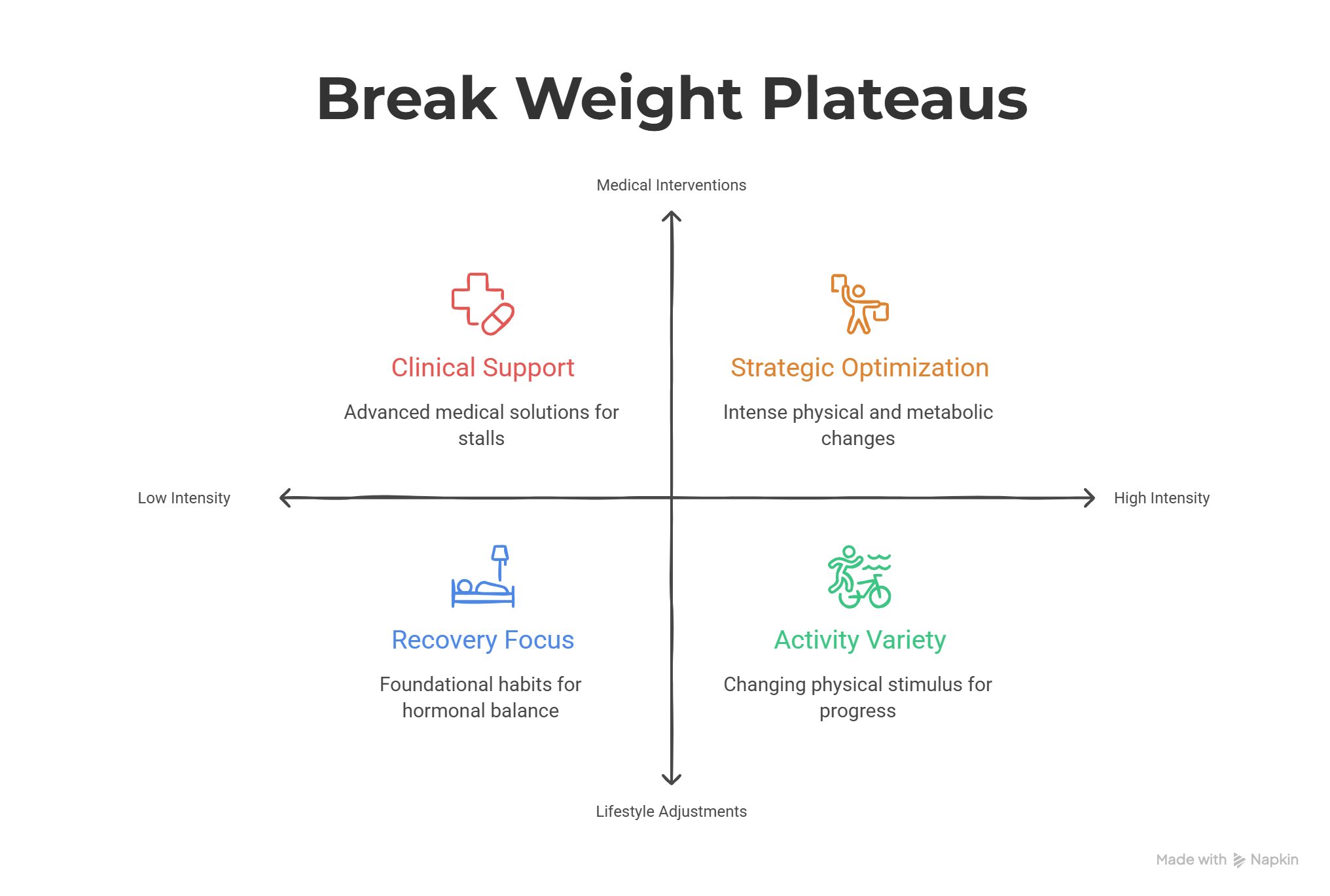
Cut another 100 to 200 calories. That's it. Most people don't need to slash intake. Just dial it back slightly. The key is finding the point where you still lose weight without your body panicking and shutting everything down. Eat too little and your metabolism crashes further. You'll feel terrible and nothing happens.
Change your workouts. If you've been running on the treadmill three times a week for six months, your body knows that workout. You're efficient at it now. Switch to weights. Try HIIT. Bike instead. Go for a walk one day and hit hard the next. Variety forces your nervous system to work harder. Your body won't have the same adaptation and you'll burn more calories processing the new stimulus.
Sleep eight hours. Not seven. Eight. This isn't optional. Five hours of sleep per night and you lose significantly less fat than someone sleeping eight, with the same calories and workouts. The research on this is solid. Cortisol shoots up when you're tired. Hunger hormones spike. Your body holds onto weight. You're also more likely to eat when you're exhausted because your brain is looking for energy anywhere it can find it.
Fix your stress. Chronic stress does the same thing sleep deprivation does. Cortisol stays elevated. Fat deposits around your midsection. Weight doesn't move. This isn't about relaxation being nice. It's about hormonal regulation being necessary for your body to cooperate with weight loss.
START FREE WEIGHT LOSS ASSESSMENT
What You Might Not Know About Your Metabolism
Metabolic changes that come with carrying excess weight start reversing as soon as you lose weight. Your cardiovascular system gets more efficient. Inflammation markers drop. Insulin sensitivity improves.
This is good. But it also means your body is constantly recalibrating as you get smaller. It's not a static situation. You're a different organism now than you were 30 pounds ago.
When Nothing Else Works
Some people do everything right and still plateau. They eat right. They sleep. They exercise. They manage stress. The scale doesn't move.
This is the point where medication makes sense.
Weight loss medications that help when diet and exercise stop working like GLP-1 agonists work. They increase fullness. They slow your stomach from emptying. They improve insulin sensitivity. The data is clear. People on these drugs lose 15 to 22 percent of body weight. Diet and exercise alone? 2 to 3 percent.
It's not cheating. It's not a failure. It's using the tools available.
Whether you're a candidate for prescription weight loss support depends on your BMI, your health conditions, how many times you've tried before, and your medical history. A doctor determines this in a conversation.
In Ontario
If you're dealing with a weight loss stall in Ontario, options exist beyond doing the same thing harder. Free OHIP-covered weight loss program options exist. You get medical supervision. You get behavioral coaching. You get medication if you need it. No out-of-pocket cost.
There are trusted weight loss services in Ontario that know what's happening to your body, why it’s happening and how to fix it. Different people need different fixes. Some need calorie adjustment. Others need sleep and stress help. Some need medication. These services can connect you with professionals who will develop a plan that works for your body.
The Bottom Line
Plateaus happen because your body is working exactly as it should. It adapted to the changes. The people who break through are the ones who change something, not the ones who just try harder at the same thing.
Figure out what's stuck. Then fix it.
START FREE WEIGHT LOSS ASSESSMENT
Frequently Asked Questions
1. Why do I stop losing weight even on a calorie deficit?
Your body gets smaller and needs fewer calories. Hunger hormones shifted. The deficit isn't a deficit anymore. Your body is trying to restore the weight.
2. How long does a plateau last?
2 to 8 weeks usually. It depends on what you change and how your body responds.
3. Does metabolic adaptation mean I need to eat even less?
No. Eating less can make it worse. You crash your metabolism further. The answer is usually 100 to 200 calories down, plus changing workouts or fixing sleep.
4. Can medication help break a plateau?
Yes. If nothing else works, medication can help.
5. Is there a free program in Ontario for plateaus?
Yes. OHIP covers eligible care. Medical supervision, coaching, and medication access may be available at no cost if you qualify.